

Blog· November 3, 2026 · 7 min read
AI in onboarding: what actually works, and what is just talk
Answering new hires' questions, drafting a first version of the journey, keeping track: what AI does well in onboarding. What it does not replace, and the rules to follow in Europe (GDPR, AI Act, works council).
Over the past two years, almost every HR tool has added "AI" to its homepage. Onboarding is no exception: assistants that answer new hires, journeys generated in one click, dashboards that "predict" departures. Some of these promises hold up. Others are sales talk. For a small or mid-sized company wondering whether AI can help it onboard people better, the right question is not "do we need AI?" but "for which specific task, from which sources, and who checks?". This guide sorts it out.
What AI does well in onboarding
Answering the questions that keep coming back
Every new hire asks the same questions as the last one: where to find the expense form, how to request leave, who to contact for an access, what an internal acronym means. These questions come at any hour, and many are never asked, because the new hire does not dare bother their manager for the third time that day.
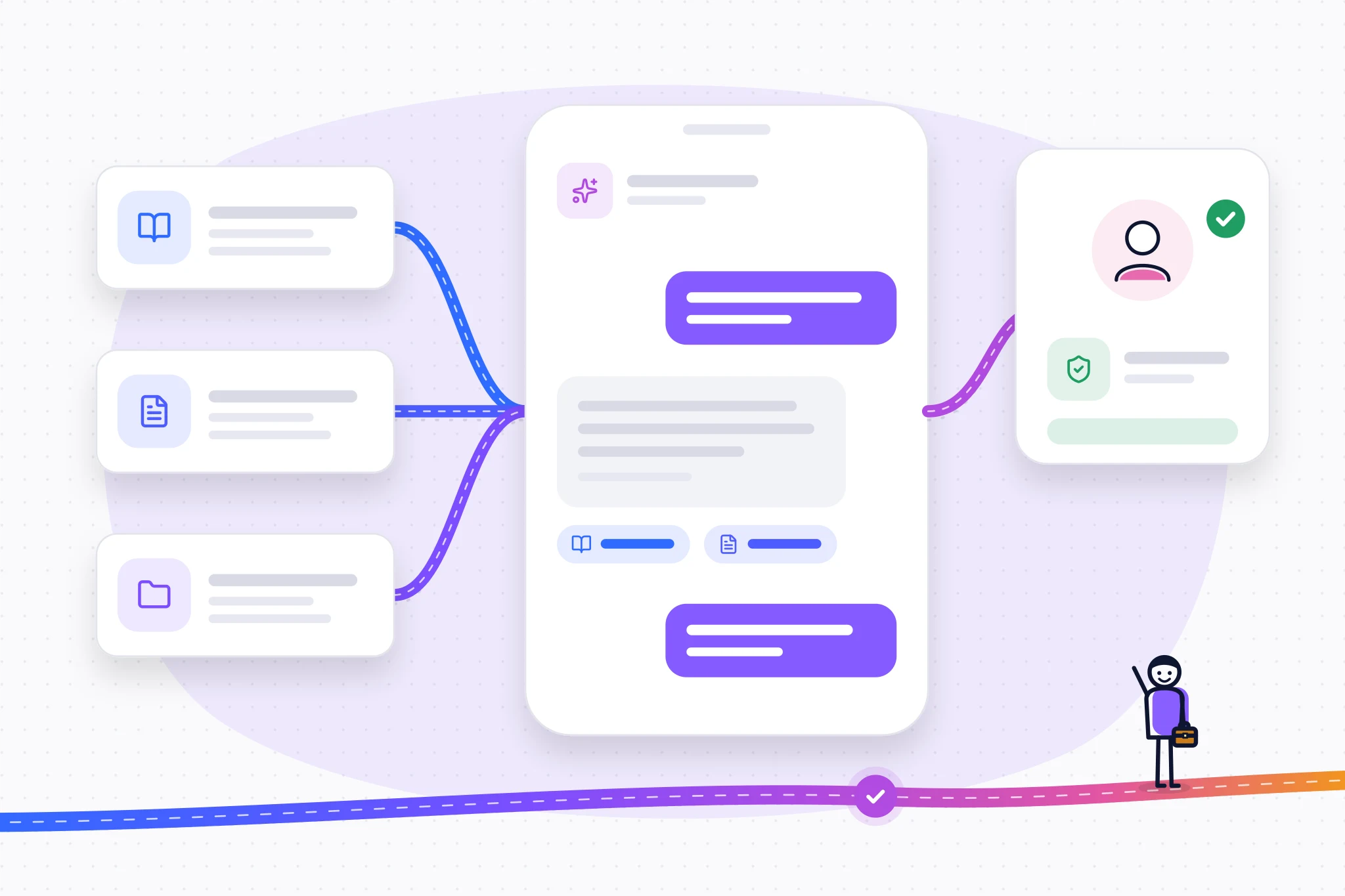
This is the most solid use of generative AI in onboarding: an assistant that answers from your documents (welcome booklet, procedures, agreements, org chart) and cites the passage its answer comes from. The new hire gets an answer at 6 pm on a Thursday, the HR team stops repeating the same thing ten times, and the manager keeps their time for what only they can do.
Turning existing material into a first draft
Most small companies have no written onboarding journey, but they do have material: a welcome booklet, job descriptions, procedures, a company presentation deck. The work that gets stuck is going from that material to a journey broken into steps, with short content and a few questions to check understanding.
AI does this shaping work well. In a few minutes it produces a first draft that would have taken an HR person days to write. The key words are first draft: more on that below.
Keeping track
Onboarding rarely fails on a big event. It fails on small things that do not get done: the end-of-first-week check-in that was forgotten, the module never opened, the question left unanswered. AI can help summarise where a new hire stands, rephrase content that is too dense, and remind people of what is left to do. Nothing spectacular, but this is often where time is saved.
What is just talk
"AI replaces the manager"
It does not. The relationship with the manager remains the first factor in successful onboarding: the manager gives the role its meaning, sets expectations and gives feedback. An assistant can take practical questions off their plate. It cannot run the end-of-probation review in their place, or notice that a new hire looks lost in a meeting.
"A personalised journey in one click"
AI only personalises from what you give it. If your documents are empty, outdated or contradictory, the generated journey will be too, with a polished form that makes the errors harder to spot. The quality of the result depends first on the quality of the material, not on the tool.
"AI predicts who will leave"
This is the most attractive promise and the most fragile one. A company that onboards ten or twenty people a year does not have enough data to train a reliable predictive model on its own departures. Useful signals do exist (falling behind on the journey, unopened modules, repeated quiz failures, long silences), but they are read with simple rules and human judgement, not with an opaque score. And a "flight risk" score attached to an employee raises a legal question, covered below.
"AI understands your company culture"
It understands what is written down. A company's culture is largely what is not: how people talk to each other, what is tolerated, who you need to know. New hires learn it from people, not from an assistant.
What makes the difference: where the answers come from
A language model generates plausible text. Without a source, it can confidently give a wrong answer: an invented notice period, a procedure that does not exist at your company, a rule taken from another collective agreement. In an HR context, a wrong answer given with confidence to a new hire is worse than no answer at all.
Hence three requirements for any tool:
- Answers grounded in your documents, not in the model's general knowledge, with the source shown so the new hire can check.
- The right to say "I don't know": when the information is not in your documents, the assistant should say so and point to a person, not improvise.
- A knowledge base kept up to date: an assistant relying on a 2022 booklet will answer as if it were 2022. The update work does not disappear, it moves.
Human review: a first draft is not a journey
Any content produced by AI should be reviewed by someone who knows the company before it reaches a new hire. This is not a precaution for its own sake: errors in generated text are plausible, so they are hard to spot for someone who is new to the company. An HR person or a manager sees them in minutes.
In practice, plan the review into the project timeline. AI saves most of the writing time; it does not remove the checking time. A tool that publishes what it generates directly, with no validation step, transfers to you a risk you cannot see.
The rules to follow (EU and France)
GDPR. The tool processes your employees' personal data: the vendor is your processor and must provide a compliant contract, the list of its own sub-processors and where data is hosted. Article 22 of the GDPR also gives everyone the right not to be subject to a decision based solely on automated processing when it significantly affects them. An AI can raise an alert; the decision about a person must remain human.
Regulator guidance. France's data protection authority, the CNIL, has published initial clarifications on deploying generative AI: start from a specific need, define authorised and prohibited uses, train users, involve the data protection officer.
The EU AI Act. The regulation lists as high-risk, in its Annex III, systems intended for recruitment, for decisions affecting the employment relationship, for allocating tasks, or for monitoring and evaluating employees' performance and behaviour. An assistant that answers a new hire's questions is not, in principle, on that list; a tool that scores new hires or evaluates their behaviour may be. The corresponding obligations were postponed to December 2027 by the "digital omnibus" adopted in 2026: now is the time to check which category your tools fall into, not a reason to wait.
French labour law. In France, no information concerning an employee personally may be collected by a system they have not been told about beforehand (article L1222-4 of the Labour Code, in French): tell new hires what the tool records. And where there is a works council (CSE), it must be informed before automated HR processing is introduced, and consulted before tools for monitoring employees' activity are put in place (article L2312-38); the introduction of new technologies is also subject to its consultation (article L2312-8). Other countries have their own equivalents: check with your local counsel.
Six questions to ask before choosing a tool
- Where do the assistant's answers come from? From your documents, with the source shown, or from the model's general knowledge?
- What happens when the information does not exist? Ask for a demo with a question whose answer is not in your documents.
- Who validates generated content before it is published? Is there a mandatory review step, or does content go out directly?
- How are new hires who disengage spotted? With explicit rules you can read and adjust, or with a score nobody can explain?
- Where is the data hosted, and is it used to train a model? Ask in writing, with the list of sub-processors.
- What does the new hire see of what is recorded? That is what you will have to explain to them, and possibly present to your works council.
At Weloom, AI does two things: it produces a first draft of the journey from your documents, which stays unpublished until your HR team has reviewed and approved it, and it answers new hires' questions from your documents, with the sources shown under each answer. Disengagement alerts rely on explicit rules (falling behind on the journey, inactivity, quiz failures) whose thresholds you set, not on a predictive model; the decision stays with HR and the manager. Data is hosted in the European Union.
Where to start: write down the ten questions your last new hires asked most often, and check whether the answer to each one is in an up-to-date document. If it is, an assistant can already save you time. If not, those documents are where to start, with or without AI.