

Blog· October 27, 2026 · 6 min read
Onboarding software: how to choose when you have 50 to 500 employees
Spreadsheet, HRIS module, LMS, dedicated platform: four families of tools for onboarding new hires, what each does well, what it leaves out, and the questions to ask before you sign.
When a small or mid-sized company starts hiring regularly, improvised onboarding starts to show. The tracking spreadsheet is out of date, the welcome booklet predates two reorganisations, and every manager welcomes people their own way. Then comes the question: do we need onboarding software? And if so, which one? The market lumps together tools that have little in common, under names that sound alike. This guide sorts them into four families, says what each does well, and offers a grid for choosing without solving the wrong problem.
First, know what you are trying to fix
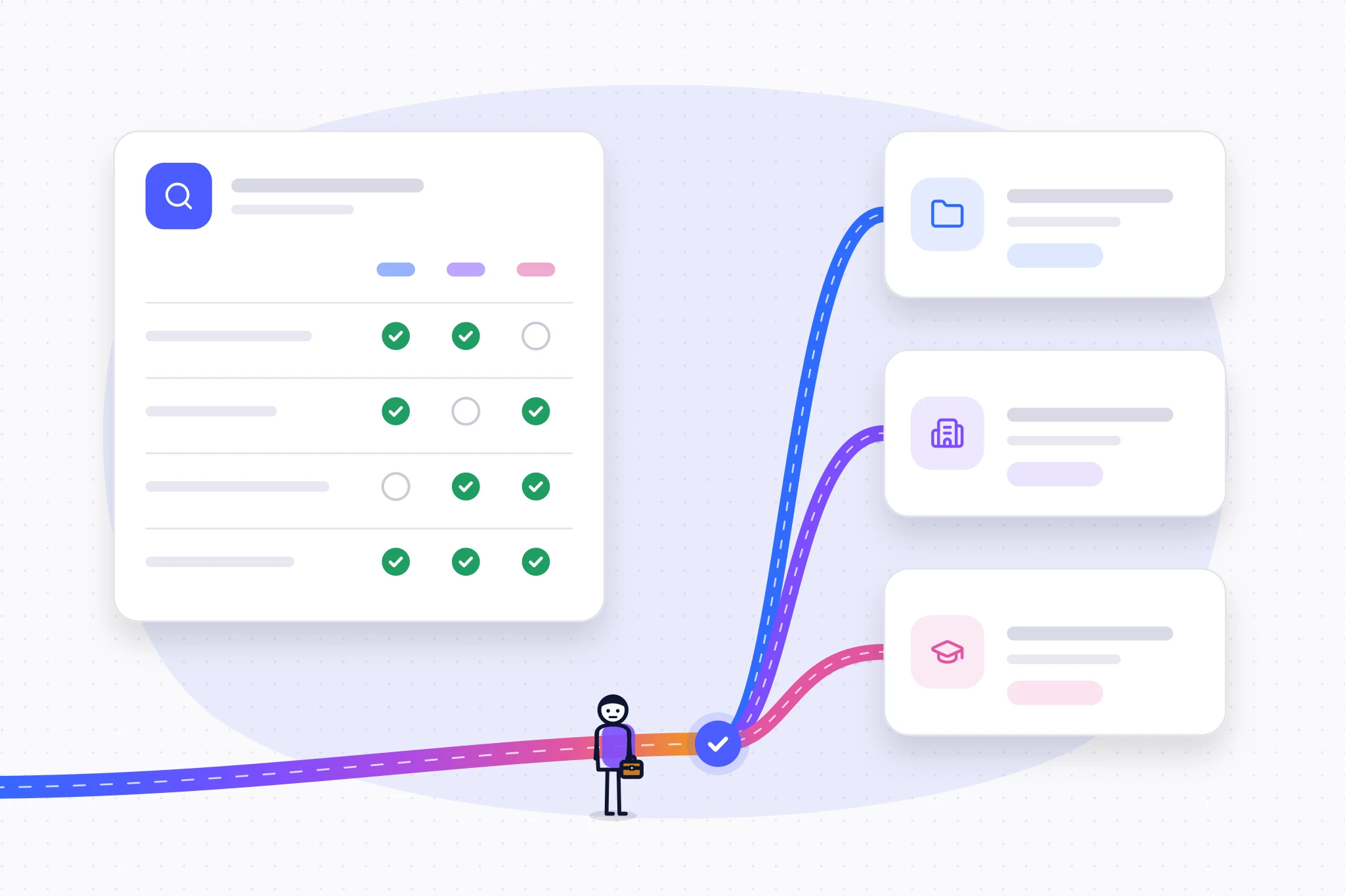
Onboarding software does not solve a single problem. Before comparing tools, write down which of these three costs you the most today:
- Admin: contracts, supporting documents, mandatory declarations, IT access, equipment. The risk is something forgotten, and it shows on day one.
- Ramp-up: the new hire has to learn your products, customers, tools and rules. The risk is slowness, and it shows after two or three months.
- Connection: knowing whether the new hire is doing well, whether their manager is following up, whether they might leave. The risk is a silent departure during the probationary period. In France, that period lasts up to four months for managers and professionals, renewable once if the industry agreement allows it (articles L1221-19 to L1221-21 of the French Labour Code).
The four families below do not cover these problems equally well. That should drive your choice, long before price does.
Family 1: the equipped status quo (spreadsheet, shared documents, wiki)
This is where almost every small company starts: a checklist in a spreadsheet, a shared folder, sometimes an internal wiki such as Notion (from €9.50 per member per month billed annually, according to Notion's pricing page, checked in October 2026).
What works: it is free or nearly free, flexible, and everyone knows how to use it. For a company hiring three or four people a year, it is often enough.
What doesn't: nobody chases anybody. The spreadsheet does not warn you that a task was skipped, the wiki does not know whether the new hire read the safety page, and information goes stale without anyone noticing. Onboarding quality depends entirely on how much time the manager and HR have.
Who it suits: companies that hire rarely, with an HR team that has time to keep track by hand.
Family 2: the HRIS onboarding module
Most HR information systems include onboarding in their core offer: employee record, document collection, task assignment, often e-signature. A few public prices for French vendors, checked in October 2026:
- Lucca lists a core HR package at €3.21 per employee per month (rate for 100 employees and more), onboarding and e-signature included;
- Eurécia offers an HR portal whose per-user price falls as headcount grows (€4.20 at 50 employees, €2.30 at 400, according to its pricing simulator), with onboarding, offboarding and e-signature;
- Factorial advertises a starting price of €6.90 per user per month.
What works: admin. The HRIS already knows the employee, their contract and their manager. Document collection and first-day tasks fit naturally. If you already have an HRIS, this module often costs you nothing extra.
What doesn't: ramp-up. An HRIS manages records, not training content. Welcome modules stay basic, and nobody answers the new hire's question at 6 pm on a Thursday. The price is calculated on your whole headcount, not on new arrivals.
Who it suits: companies whose main problem is admin, and who already have an HRIS or plan to get one.
Family 3: the LMS (learning platform)
An LMS is for creating and delivering training: modules, quizzes, completion tracking. Some are used for onboarding. 360Learning, for example, lists a Team plan at €8 per active user per month, capped at 100 users (checked in October 2026). HR suites such as Leapsome also offer a learning module on top of their per-employee plans.
What works: structured ramp-up. You know who completed what, with what score.
What doesn't: someone has to write the content, and that is where many projects stall. An empty LMS is useless, and a small company does not always have someone to write twenty modules. Admin and the human follow-up of the probationary period are usually out of scope.
Who it suits: companies that already have training content, or someone dedicated to producing it, and a training need that goes beyond onboarding.
Family 4: the dedicated onboarding platform
These tools are built for onboarding end to end: preboarding before day one, role-based journeys, the manager's and buddy's roles, follow-up milestones. In France, Workelo and HeyTeam are the most cited names; neither publishes its prices. Among European vendors, Appical lists a per-company plan starting at €399 per month (checked in October 2026). Specialists that do not publish prices work on quotes, often with an annual commitment.
What works: the new hire's experience and the connection. The journey starts before day one, the manager knows what to do and when, and milestones prompt regular check-ins.
What doesn't: here too, someone has to write the content, and the initial setup takes time. Several vendors reserve some features (e-signature, HRIS integration, single sign-on) for higher tiers: read the pricing grid line by line.
Who it suits: companies that hire enough for onboarding to become a process in its own right, with retention or productivity at stake.
The selection grid: seven questions to ask every vendor
A demo always goes well. These questions show what is behind it.
- Who creates the content, and how long does it take? Ask how long it takes, in practice, to go from your existing documents to a first usable journey. This is where most projects stall.
- What does the new hire see before day one? Access from the moment the contract is signed changes the first day. Check what is available during preboarding, and what the new hire can do without a company IT account.
- Who answers their questions? An FAQ, a named contact, an assistant? And based on what: your documents, or generic advice?
- What does the manager see? A good tool takes work off the manager's plate instead of adding to it. Ask to see the manager's screen, not just HR's.
- How do you spot a new hire who is disengaging? Delays, unopened modules, milestones with no feedback: the tool should alert you before the end-of-probation review, not after.
- What is the price based on? Total headcount, active users, a flat fee, or number of new hires? A 200-person company hiring twenty people a year pays very different amounts depending on the unit. Also ask about commitment length and setup fees.
- Where is the data, and who processes it? In the EU, the vendor is your processor under the GDPR: it must give you a data processing agreement that complies with Article 28, the list of its own sub-processors and where the data is hosted.
Three common mistakes
Buying for admin when the problem is ramp-up. A contract signed online does not make anyone productive faster. If your new hires take six months to become effective, a document-collection module will not change that.
Underestimating the content work. The software is rarely the bottleneck; the time needed to write the journeys almost always is. Assess that hidden cost before you sign.
Forgetting the manager. Onboarding happens first in the relationship with the manager. A tool the manager never opens leaves HR alone with a dashboard.
At Weloom, we chose to build a dedicated platform for small and mid-sized companies that starts from your existing documents: the journey is generated by AI, approved by your HR team before it is published, then followed through to the end of the probationary period, with an assistant that answers from your documents and alerts when a new hire disengages. Pricing is based on new hires onboarded, not headcount: €129 excl. VAT per month for 10 new hires a year, then €49 excl. VAT per additional new hire. Free 14-day trial.
Where to start: look back at your last three onboardings and note, for each one, what went wrong: an admin oversight, a new hire slow to become autonomous, or a departure nobody saw coming. The answer tells you which family to look in.