

Blog· September 21, 2026 · 8 min read
Digital employee handbook: a complete guide for HR in SMEs and mid-sized companies
What a digital employee handbook should contain, what the regulations say, and how to turn it into a living journey rather than a PDF.
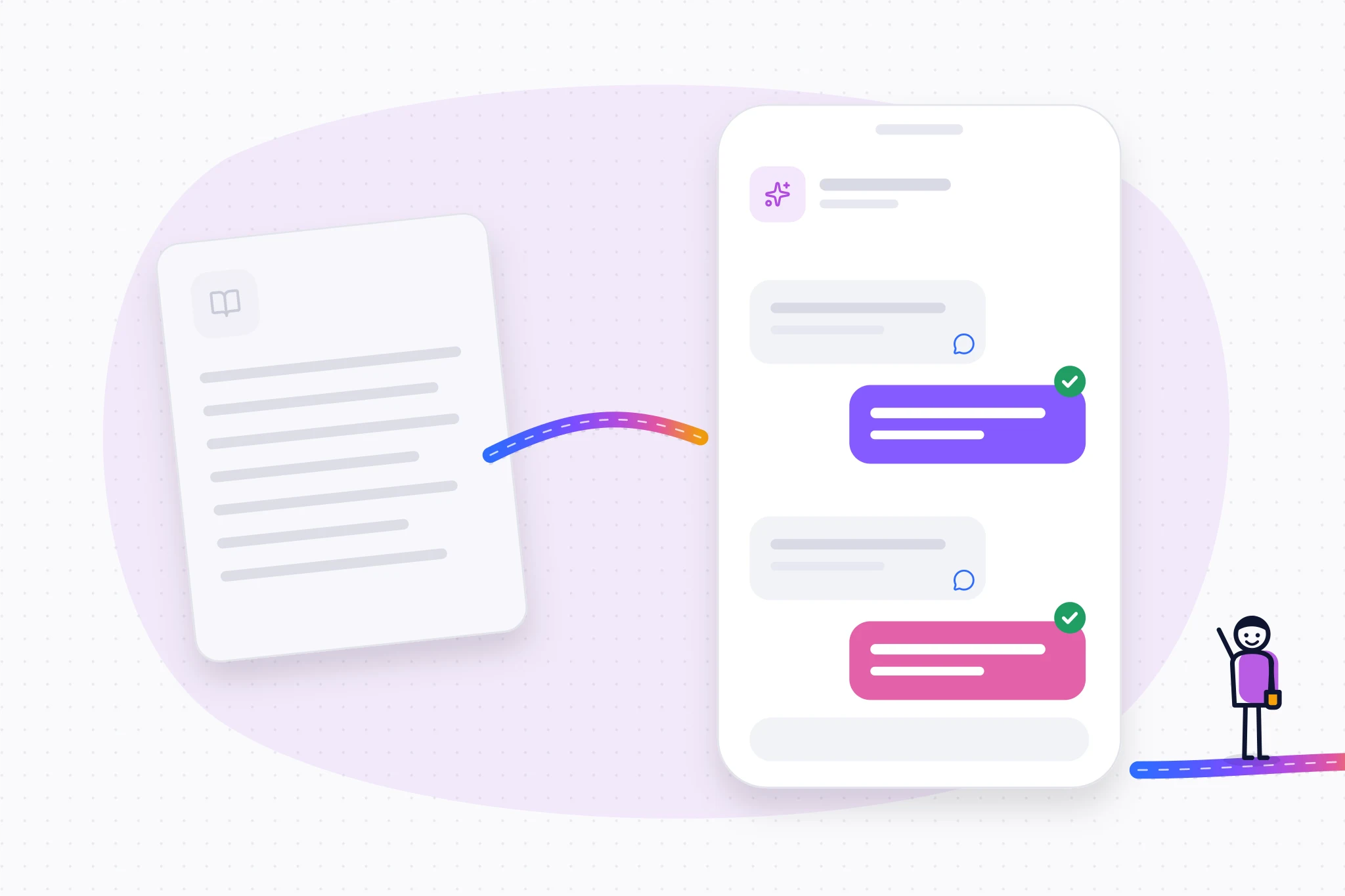
A digital employee handbook (what French HR teams call a livret d'accueil digital) is a digital onboarding guide that brings together procedures, training paths, validation quizzes and an always-available assistant to answer newcomers' questions. Adopting one makes new employees autonomous faster, reduces the repetitive requests HR teams receive and ensures traceability of the knowledge passed on. The following sections cover its design, its legal obligations and its implementation.
In brief:
- A digital employee handbook speeds up new hires' autonomy, reduces repetitive questions and provides complete traceability of their onboarding journey.
- It should contain administrative information, safety instructions and an interactive module with a conversational assistant to answer questions instantly.
- Implementation involves organizing a structured 90-day journey, with human support that is essential to strengthen engagement and retention.
- Regulatory compliance requires recording data processing in the record of processing activities, carrying out an impact assessment and informing employees clearly.
- A platform like Weloom automates the indexing of existing documents, generates personalized journeys and hosts data in Europe to simplify rollout.
What is an HR-focused digital employee handbook: content and format
Unlike a static PDF sent by email, an HR-focused digital employee handbook brings several types of content together around a structured journey. It combines administrative information, safety instructions, an introduction to the organization and job training, all accessible from a single digital space that new hires can consult at their own pace.
The components that make the difference between a simple document and a true onboarding tool are:
- Administrative and contractual information (contract, supplemental health insurance, tools, access).
- Occupational health and safety instructions specific to the position and the site.
- The job description, the organizational chart and an introduction to the teams.
- Training micro-modules, short videos and validation quizzes.
- A conversational assistant indexed on internal documentation, able to answer questions as they arise.
This combination of static documents and interactive journeys also makes it possible to keep a record of what has been consulted and validated, which is useful in the event of an inspection or a dispute.
Measurable benefits for SMEs and mid-sized companies: HR productivity and retention
The value of a digital employee handbook is not limited to the newcomer's comfort. A quantitative study published in 2025 shows that structured onboarding improves talent retention by acting on two levers: the interpersonal connections built during onboarding and the employee's level of engagement from the very first weeks.
Structured onboarding strengthens talent retention through engagement and interpersonal connections, according to a 2025 study published in MDPI, which models these mediating effects on a sample of recently onboarded employees.
For an HR team, this translates concretely into fewer repetitive questions sent to managers, faster autonomy and a lighter administrative workload. Three indicators make it possible to track these effects over time: the journey completion rate, the average time to autonomy on key tasks, and the volume of HR requests per new hire during the first three months.
Obligations and security: what the handbook must contain to be compliant
A digital employee handbook is not just a convenience tool; it also serves a regulatory function. The French Ministry of Labor's employer fact sheet points out that welcoming a newcomer involves helping them find their bearings by providing a handbook setting out the internal procedures and the safety measures applicable to their position.
On the data protection side, several rules govern the digitization of HR processes:
- HR data processing must be recorded in the record of processing activities.
- A data protection impact assessment (DPIA) should be considered whenever the tool processes sensitive data or relies on advanced automated mechanisms.
- Employees must be clearly informed of how their data is used and, where applicable, of the involvement of artificial intelligence.
These requirements are based on the CNIL's framework on human resources management (the CNIL is France's data protection authority), which also recommends technical measures such as access restrictions, logging of consultations and hosting located in Europe.
Pro tip: involve your data protection officer from the design stage of the handbook rather than at launch: a DPIA carried out after the fact always costs more to correct than to anticipate.
How to structure an effective digital onboarding journey
Research on onboarding practices converges on one finding: the most effective journeys do not rely solely on distributing documents, but on supervised on-the-job experience. A systematic review published in 2023 identifies on-the-job training as the most effective strategy for supporting the newcomer's adjustment and skill mastery.
A well-structured digital journey generally follows this sequence:
- Preboarding: sending administrative information and a first introduction to the company culture before day one.
- Day one: immediate access to the handbook, team introductions, first guided tasks and safety instructions.
- 30-day phase: completion of mandatory training modules through quizzes, with support from a designated mentor.
- 60-day phase: growing autonomy on core responsibilities, with regular feedback check-ins.
- 90-day phase: full review, measurement of engagement and adjustment of the journey for future hires.
The mentor's role remains central throughout this cycle: the digital assistant answers factual questions, but human support remains the factor that creates the sense of belonging identified by retention research.
Technical features and selection criteria for a digital employee handbook
Choosing the right tool means evaluating specific capabilities rather than relying on a list of marketing features. Several technical criteria determine the real quality of a digital employee handbook:
- Automatic indexing of internal documents and semantic search able to find the relevant information in a PDF or a procedure.
- A conversational assistant trained on the company's own documentation rather than on generic answers.
- Generation of personalized journeys by position, site or department.
- Integrations with existing tools (HRIS, company directory, single sign-on).
- Detailed reporting on new hires' progress and access traceability to meet audit requirements.
Pro tip: always ask where the data is hosted before signing: hosting located in Europe simplifies compliance and avoids data transfers outside the applicable regulatory framework.
Resources such as the features presented by Clailoop make it possible to compare the logic of directories and internal communication with that of an onboarding-focused handbook, two complementary but distinct approaches.
Deployment checklist and realistic timeline for an SME or mid-sized company
Rolling out a digital employee handbook follows a sequence of steps that can fit within a few weeks for a mid-sized organization.
- Document audit: inventory and sort existing procedures, job descriptions and instructions.
- Indexing: load these documents into the chosen tool and check that they are properly structured.
- Journey creation: organize the content into preboarding, day one and 30/60/90-day sequences.
- Pilot: test the journey with one or two new hires before a general rollout.
- Mentor training: make sure mentors understand their role as a complement to the digital tool.
- Launch and follow-up: activate the journey for all new hires and track the indicators defined beforehand.
This sequence involves HR as project leads, the DPO for compliance, managers for job-specific content and IT for technical integrations. A detailed checklist template is also available on the HRpro blog, which offers practical resources on HR management.
What field experience teaches about digital onboarding
The most common mistake is to pit the AI assistant against human support, when the two play distinct and complementary roles. The AI absorbs repetitive factual questions; the mentor builds the bond that supports retention. HR teams are better off testing a journey on a small scope before rolling it out widely, rather than trying to get the perfect version right from launch.
— Nicolas
Weloom: a platform designed to automate this onboarding
Structuring a digital employee handbook takes time that many HR teams in SMEs and mid-sized companies do not have. We built a platform to meet exactly this need: automatically indexing the company's internal documents, whether PDFs, Word files or existing procedures, to turn them into a repository an intelligent assistant can use.
In practice, our platform makes it possible to:
- Generate personalized onboarding journeys from existing documentation, without rewriting each piece of content.
- Provide an always-available assistant that answers new hires' questions based on internal documents.
- Reduce repetitive requests to HR teams by letting the assistant handle factual questions.
- Track each new hire's progress in real time, from preboarding to offboarding.
- Host data in Europe with built-in GDPR compliance, detailed on our security page.
Our plans adapt to the size of the HR team and to hiring volume, with several feature tiers: for details of current plans and prices, see our pricing page. To see how this applies to your existing documentation, the simplest way is to view our full overview and start a trial.
Frequently asked questions
What must a digital employee handbook contain?
A digital employee handbook must set out the internal procedures and the safety measures applicable to the position, according to the French Ministry of Labor's fact sheet. It complements in-person safety training without replacing it and should always point to the mandatory training for the position.
Which GDPR obligations apply to a digital employee handbook?
HR data processing related to the handbook must be listed in the record of processing activities, and an impact assessment may be necessary under the CNIL's HR framework. Employees must also be clearly informed of any use of artificial intelligence in their onboarding journey.
How long does it take to deploy a digital employee handbook?
The timeline depends on the volume of documents to index and the complexity of the journeys to build, but a pilot limited to one or two new hires generally makes it possible to test the tool before a general rollout within a few weeks.
Which indicators should be tracked after launching a digital employee handbook?
The most relevant indicators are the journey completion rate, the average time to autonomy and the volume of questions sent to HR during the first months. These measurements make it possible to adjust the content and structure of the journey as hiring continues.
Can an AI assistant replace the mentor in onboarding?
No, the two roles are complementary: the assistant handles repetitive factual questions, while the mentor creates the interpersonal bond that fosters engagement and retention, according to the 2025 MDPI study.
Sources
- The Invisible Bond: Exploring the Sequential Mediation of Interpersonal Connections and Engagement in the Relationship Between the Onboarding Process and Talent Retention (MDPI, 2025)
- 2023 systematic review on the effectiveness of on-the-job training (PMC)
- Employer fact sheet — Welcoming a new employee (October 2024)
- The human resources management framework: questions and answers | CNIL