

Blog· October 13, 2026 · 6 min read
Onboarding in IT consulting: integrating a consultant who leaves straight for a client
In IT services and consulting firms, the new hire spends three days at the office, then disappears to the client's site. How to build an onboarding that holds up at a distance, from the signature to the end of the probation period.
In an IT services company or a consulting firm, onboarding has a feature that almost every onboarding guide ignores: the new hire doesn't stay. They sign, spend a morning — sometimes three days — at the office, pick up their laptop, then leave for the client. From then on, they live in another company's premises, with its badges, its tools, its rituals and its colleagues. Their employer becomes an email address and a manager they see once a month.
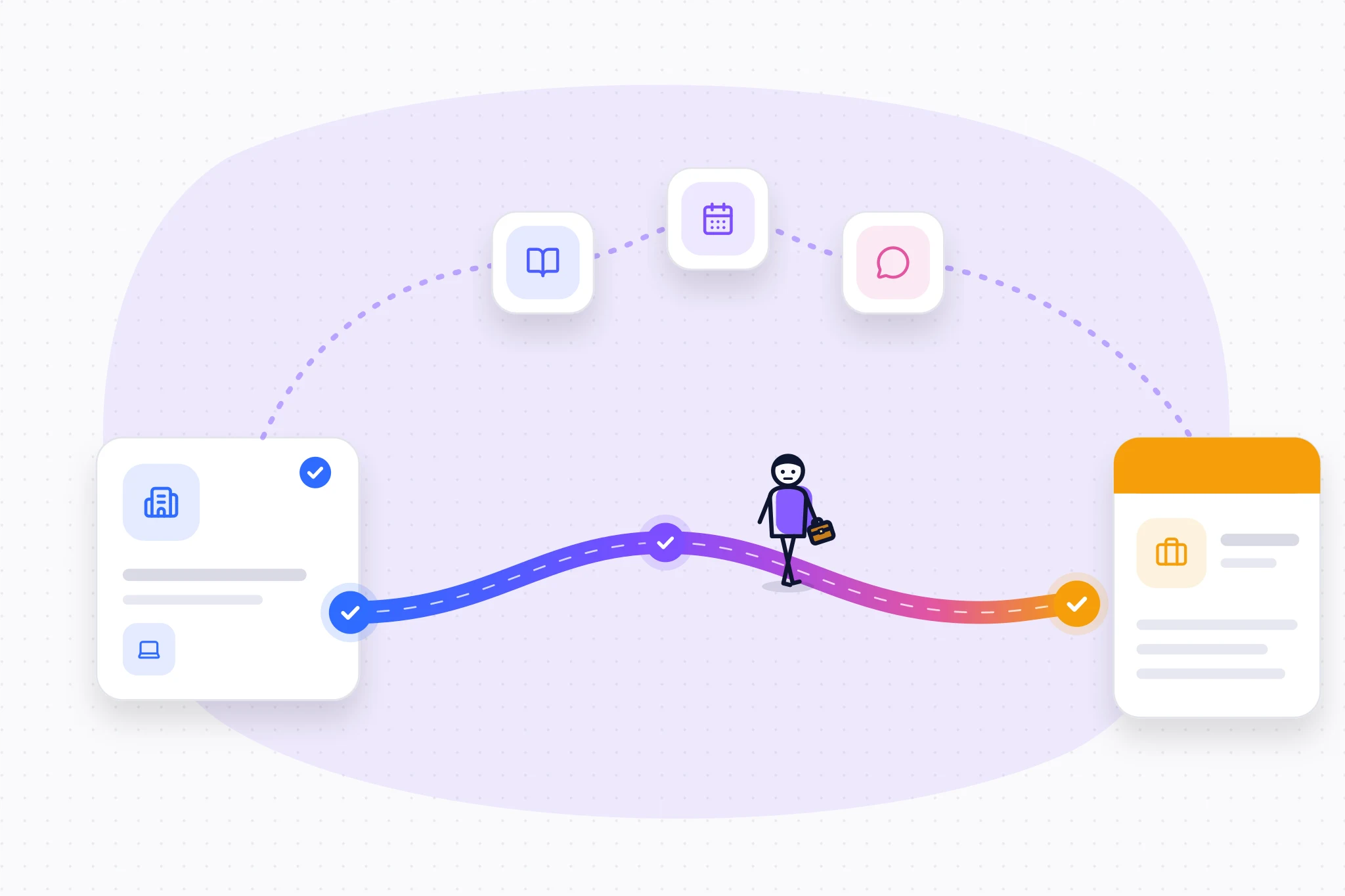
Every HR director in the sector knows the result: a consultant who knows their client's org chart better than their own company's, who doesn't know whom to ask an HR question, and who discovers their employer's culture… during their exit interview. This guide proposes an onboarding designed for this exact case: short on site, long at a distance.
Why classic onboarding doesn't work in consulting
Time on site is kept to a minimum. Every day spent at the office is a day not billed. Commercial pressure therefore pushes to compress the welcome — and what goes first is not the paperwork (mandatory) but getting to know the company, its way of working and its people.
Two onboardings overlap. The consultant is onboarded at the client (their daily work, their tools, their assignment) and at their employer (their contract, its rules, their career). The first is carried by the client, often well. The second is carried by no one, since no one from the consulting firm sits next to them.
The manager is far away, and manages a lot of people. A consultants' manager — project director, branch manager, business manager — often oversees dozens of people spread across as many clients. They can't "drop by" the new hire the way the manager of an in-house team would.
The probation period, however, runs as usual. In France, for an executive (cadre), the Labour Code caps it at four months, renewable once if an extended industry agreement allows it, for a maximum of eight months (articles L1221-19 and L1221-21 of the French Labour Code). That is as many months during which the new hire can leave overnight — and during which your only source of information on their morale is the client.
The principle: short on site, long at a distance
Rather than trying to do everything during the two or three office days, spread the onboarding over three stages, and accept that most of it happens during the assignment.
1. Before day one: everything that can be done remotely
A senior consultant's notice period often lasts several months: precious time, and usually wasted (our preboarding guide covers it in detail). For a consulting firm, three priorities:
- Paperwork done before arrival: contract, health insurance, supporting documents, signed online. Office days should not be spent filling in forms.
- Introducing the company: who we are, how we work, our offers and client references, how the branches are organized, the names and faces of key people. In short formats, spread over the weeks of the notice period.
- The consultant's rulebook: how to log time, request leave, file an expense report, whom to call if something goes wrong at the client. It is the most useful documentation and the least often written down.
2. Office days: what requires being together
What remains for the few days on site are the things that can't be done through a screen:
- Equipment handed over and tested, access opened and checked, two-factor authentication set up.
- Meetings: the manager, one or two consultants from the same practice, the HR contact. A consultant who knows three faces at their employer doesn't experience their assignment the same way as one who knows none.
- The assignment brief: the client's context, its stakes, what is expected of the consultant, the client-side contacts, the points to watch. A written brief, reviewed by the account manager or project director, beats a hallway conversation.
- A buddy: an experienced consultant, ideally one who has already worked at the same client, whom the new hire can call without going through the hierarchy.
3. During the assignment: the journey continues
This is where most onboardings stop, and this is where everything is decided. During the first months of the assignment, the consultant should keep hearing from their employer — and not only timesheet reminders:
- A rhythm of content: one short piece a week on the culture, internal tools, communities of practice, training, career management. Fifteen minutes, to read on the train.
- Dated checkpoints, held by the manager even remotely: a call at the end of the first week, a check-in at one month, a review at two or three months before the end of the probation period. A 30-60-90 day onboarding plan helps set them from the signature.
- A channel for questions: the new hire has some, and hesitates to ask a manager they rarely see. An up-to-date FAQ, the HR contact, or an assistant that answers from the internal documentation, available in the evening.
- Group moments: branch afterwork events, technical communities, annual company day. They are what creates a sense of belonging to the firm rather than to the client.
The signals to watch
At a distance, you don't see a new hire disengage. So define in advance what should raise a flag:
- Unopened content: a new hire who hasn't looked at anything in three weeks isn't necessarily demotivated, but deserves a call.
- Postponed checkpoints: a one-month check-in postponed twice is a signal, on either side.
- Silence on questions: a new hire who asks no questions in their first weeks is rarely one who has understood everything.
- Client feedback: valuable, but it measures the client's satisfaction, not the consultant's engagement with their employer.
The principle is simple: what isn't measured at a distance doesn't exist. A view showing, new hire by new hire, what has been done and what hasn't lets the manager focus their calls on those who need them.
The bench case
A new hire may also arrive without an immediate assignment. Time on the bench is then an opportunity: it is the only moment when the consultant is available for the company itself. The first days can be used for a fuller onboarding — internal training, contributing to a community of practice, preparing client meetings — provided it is ready in advance. The worst scenario is the consultant with no assignment and no programme, waiting at home for a call from sales.
What to document once and for all
Consulting firms repeat the same onboardings dozens of times a year. That is an advantage: what is written once serves every arrival. The minimum list:
- The presentation of the company, its offers, its branches and its key people.
- The consultant's practical guide (time, leave, expenses, equipment, support).
- Security and confidentiality rules at client sites.
- The assignment brief template.
- The checkpoint calendar up to the end of the probation period.
- Contacts: manager, HR, buddy, IT support.
The rest — the specifics of an assignment, a client, a technology — is added case by case. Our onboarding checklist details the steps common to every onboarding.
At Weloom, onboarding continues during the assignment: the journey is generated from your documents (company presentation, consultant guide, security rules), approved by your HR team, then delivered week after week, from preboarding to the end of the probation period. The consultant asks their questions to an assistant in your company's colors, which answers from your documents. The manager sees who is progressing and who hasn't opened anything. 14-day free trial.
Where to start: take your firm's last three onboardings and note, for each one, the last piece of content the new hire received from you after leaving for their assignment. If the answer is "the contract", that's where to start.