

Blog· November 16, 2026 · 6 min read
Offboarding checklist: an employee's departure, step by step
Mandatory documents, access to revoke, knowledge to hand over, exit interview: the offboarding checklist for small and mid-sized companies, from the resignation to the last day, and what to prepare from day one.
Companies spend weeks preparing a new hire's arrival. The departure is often settled in two days: farewell drinks, a laptop handed back, a badge forgotten in a drawer. Yet a poorly prepared departure is expensive for the people who stay: an account left open, a client who no longer knows who to call, knowledge that walks out the door and that the replacement will have to rebuild alone. This guide gives the complete offboarding checklist, from the announcement to the last day, and the part people forget: what to prepare from the very first day.
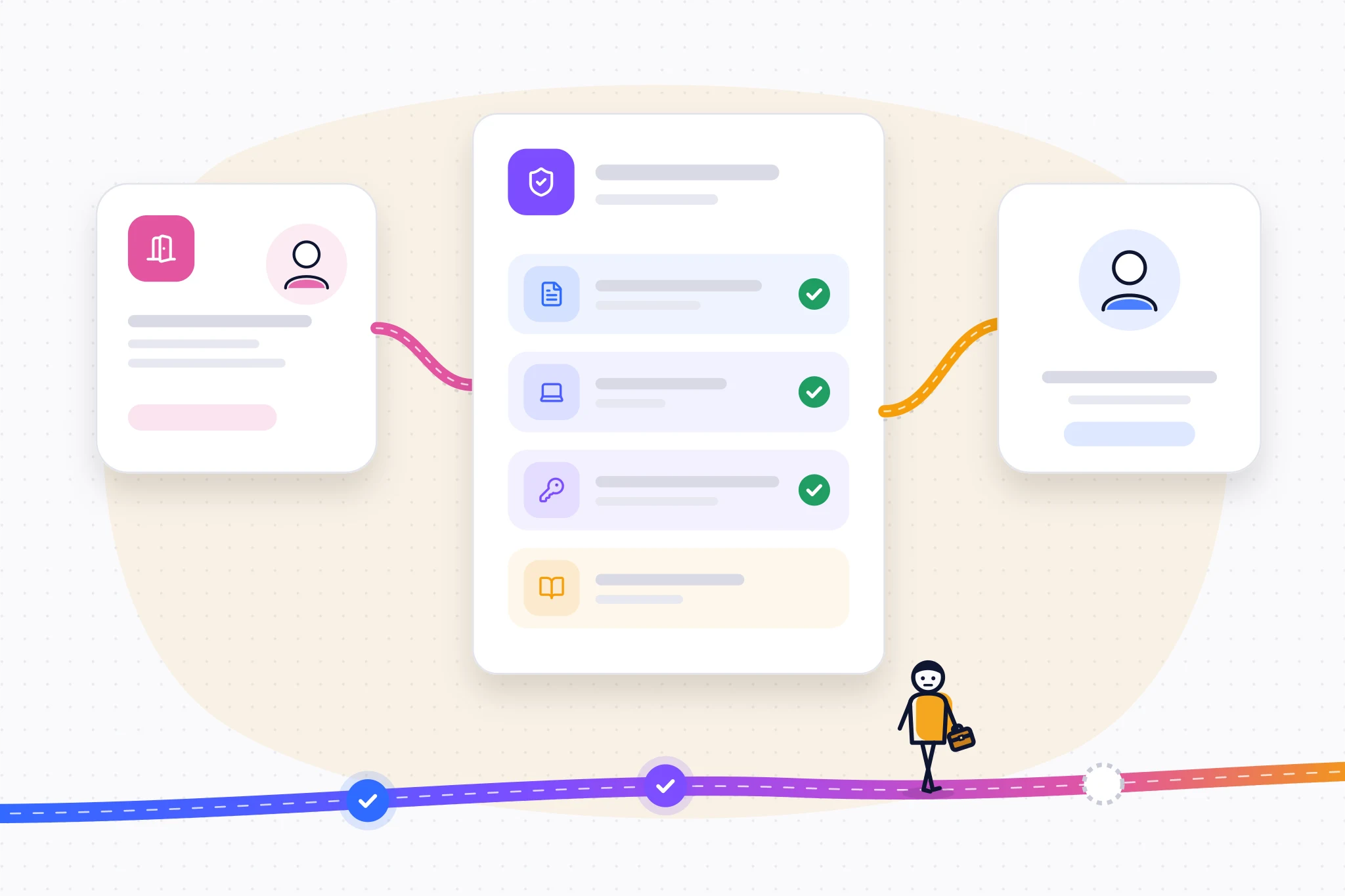
Why offboarding deserves a checklist
A departure touches four topics at once, rarely owned by the same person:
- the law: documents to hand over, in specific forms;
- security: accounts, keys and devices to recover;
- knowledge: files, contacts and work habits to pass on;
- the relationship: the last impression the person keeps of the company, and will share.
Without a list, everyone assumes someone else is on it. The manager thinks HR revoked the access, HR thinks the manager organised the handover, and IT hears about the departure a month later. A checklist does not add work: it says who does what, and when.
As soon as the departure is announced
Whether it is a resignation, the end of a fixed-term contract, a mutually agreed termination or a retirement, the first few days decide how the rest goes.
- Set the end date and confirm it in writing. Any notice period, remaining leave to take or pay out, and the last day actually worked.
- Name one person responsible for the departure. Usually the manager, backed by HR. One person who keeps the list up to date.
- Decide how to announce it. Who hears first (the team, clients, partners), from whom, and with what message. A client who learns their contact has left through an out-of-office reply is the scenario to avoid.
- Start the replacement, if there is one. An overlap between the person leaving and the person arriving is the best handover tool there is; it is decided now, not in the last week.
During the notice period: pass on what the person knows
This is the most neglected step, and the most expensive one when it is missing. What someone knows when they leave is often exactly what their successor will lack in the first month.
- List the ongoing files, with for each one its progress, the next deadline and who takes it over.
- List the key contacts: clients, suppliers, partners, internal counterparts. For each one, a line on the nature of the relationship and what to know.
- Write down what is written nowhere. Shared passwords (to be changed afterwards), procedures the person did from memory, the workarounds for a faulty tool. A good question to ask: "what do you do every month that nobody else knows how to do?"
- Hold the handover face to face when possible: one or two sessions with the person taking over, rather than a document sent on the last day.
What you collect here is more than a handover note. It is the raw material for the next person's onboarding: their employee handbook, their 30-60-90 day plan, the questions they will not have to ask.
The documents to hand over
This section describes French law, where Weloom's customers operate; other countries have their own rules. At the end of the contract, a French employer gives the employee three documents, whatever the reason for leaving:
- The certificate of employment (certificat de travail, article L1234-19 of the French Labour Code).
- The certificate for France Travail, the public employment service, which lets the employee claim unemployment benefits (article R1234-9).
- The final settlement receipt (reçu pour solde de tout compte), which lists the amounts paid. The employee can challenge it within six months of signing it (article L1234-20).
Depending on the case, add information on continued health and disability cover, the status of employee savings plans, and any clauses that still apply after the departure (confidentiality, non-compete). Your payroll provider or accountant knows the specifics of your collective agreement: they are the right people to check the list.
Equipment and access
This is the security side, and the one where an omission stays invisible until the day it causes trouble.
- Recover the equipment: laptop, phone, badge, keys, fuel card or company card, vehicle. A named list made at arrival makes this step trivial; without it, you discover the monitor lent three years ago.
- Revoke access on the last day, not before, not after. Email, business software, shared tools, building access. Before, the person cannot work during their notice; after, the company stays exposed.
- Redirect what needs to be: the mailbox to a colleague, or an explicit out-of-office message for a set period; subscriptions and licences in the person's name; documents stored on their device.
- Change the shared passwords the person knew.
As for the departing person's personal data (file, reviews, correspondence), the French data protection authority (CNIL) points out that it cannot be kept indefinitely: each category has a retention period suited to its purpose (CNIL guide, in French). Our article on HR documentation covers the most common periods.
The exit interview
An employee who is leaving has nothing left to lose: it is often the moment they say what they would not have said while in post. An exit interview is not mandatory, but it is one of the most candid sources of information a company has.
A few questions are enough:
- What made you decide to leave?
- What could have made you stay?
- What would you have liked to know when you arrived?
- What would you tell the person replacing you?
- Would you recommend the company to someone you know? Why?
The third and fourth questions loop straight back to onboarding. They echo the fresh-eyes report: what the new hire noticed on arrival, the person leaving can confirm, or say what has changed since.
As with the fresh-eyes report, the interview is only worth what you do with it. One reason for leaving is an anecdote; the same reason from three people in a row is an organisational problem.
The last day
- Hand over the end-of-contract documents and have the final settlement receipt signed.
- Recover the remaining equipment, revoke access.
- Say goodbye. A message to the team, a moment together: the person leaving becomes a former employee, who will talk about you, may recommend candidates, and may come back one day.
The checklist at a glance
| When | What | Who |
|---|---|---|
| Announcement | End date, notice, leave, internal and external announcement | Manager + HR |
| Announcement | Replacement decision, possible overlap | Manager |
| Notice period | Ongoing files, key contacts, unwritten knowledge | Employee + manager |
| Notice period | Face-to-face handover | Employee + successor |
| Notice period | Exit interview | HR |
| Last day | Certificate of employment, France Travail certificate, final settlement | HR / payroll |
| Last day | Equipment returned, access revoked, passwords changed | Manager + IT |
| After | Redirections, data retention periods, review of reasons for leaving | HR |
What to prepare from day one
The best offboarding is prepared on the day of arrival. The list of equipment handed over, the list of access granted, procedures written down as you go rather than kept in someone's head: everything recorded at arrival can be undone cleanly at departure. Conversely, an onboarding checklist that does not record what was handed over makes the departure checklist impossible to keep.
At Weloom, offboarding is a journey in its own right: a checklist grouped by theme (admin, IT, logistics…), templates by role (standard, technical, sales, manager), and, for the steps that call for it, a double sign-off by HR and by the person leaving, so nobody wrongly assumes the other took care of it. Documents to hand over or sign are attached to the relevant step. This feature is part of the Growth and Enterprise plans.
Where to start: take the table above, fill the "Who" column with real names, and keep it next to your arrival checklist. At the next departure, you will only have to run through it.